
Health and illness
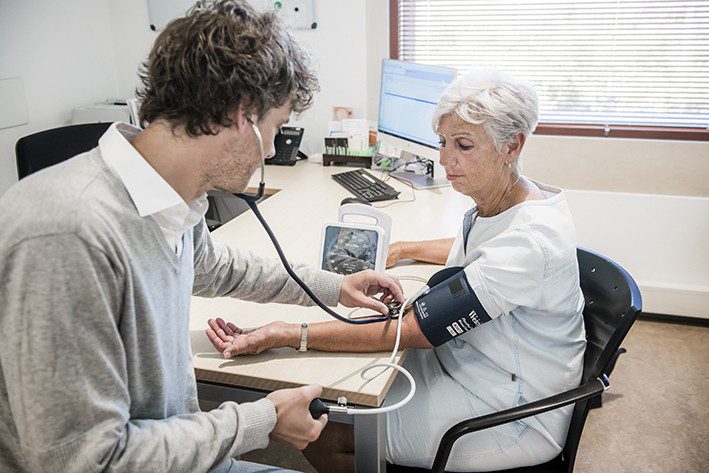
Each season brings new points of attention and health risks. A number of topics are discussed here.
Do you suffer from the following symptoms?
- Pain or burning sensation when urinating
- Having to urinate frequently in small amounts
- Frequent urge to urinate
- Sometimes blood in the urine
These are common symptoms of a bladder infection. To determine whether it is a bladder infection, your urine will be tested.
- What should you do?
For a good urine test, it is important:
- Wash thoroughly with water before urinating.
- Morning urine is the most concentrated and therefore easier to test.
- First urinate a little and then collect some urine (a layer of 1 cm in a container is sufficient).
- Use a clean plastic container. Ask the assistant where best to get one. If you suffer from bladder infections frequently, it is handy to have a few at home.
- Write your name and date of birth on the jar.
- Submit the urine as soon as possible (< 2 hours). If that is not possible, store the container in the refrigerator. This may be done for a maximum of 24 hours.
- You will receive a urine form from the assistant to fill out.
- Instructions for collecting urine from non-toilet-trained children:
- Give the child plenty to drink. Children under 2 years of age will usually urinate within 20 to 30 minutes.
- Spread the labia or retract the foreskin and clean the inside of the labia or the penis with plenty of water (no soap) by running the shower over it or wringing out wet cotton balls (do not scrub).
- Have the child lie or walk around on a changing pad with exposed genitals; let them urinate the first bit and then collect the urine with a clean potty.
- If this is unsuccessful, attach a urine bag and check every 10 minutes for urine production. Leave the urine bag in place for a maximum of 1 hour (see www.thuisarts.nl).
- The result
The assistant will test your urine for you. The results are usually available the same afternoon. You can call the practice after 2:00 PM for this. If you have a bladder infection, it may clear up within a week without medication. You should drink plenty of fluids (one and a half to two liters per day) and you can take a painkiller. If the symptoms do not go away, you have a fever, belong to a risk group (men, pregnant women, patients with diabetes mellitus, an immune disorder, urinary tract abnormalities, or an indwelling catheter), or the symptoms are very severe, you will usually receive a course of antibiotics. You must complete this entire course.
What can you do yourself?
You can do a few things yourself to ensure that the bladder infection clears up faster or to prevent a bladder infection.
- Drink plenty of (water)
- Empty your bladder completely. Take your time and sit down comfortably.
- If you feel the urge to urinate, actually go urinate. So do not put it off.
- It is wise to urinate after sex. This flushes away bacteria that have accumulated around the urethra.
- Wipe from front to back after using the toilet. This prevents bacteria from the stool from reaching the urethra.
Sometimes the GP wants to conduct further tests. You may then need to submit another urine sample. You will be informed of this by the assistant.
Costs
The urine test performed by the assistant at the practice is free of charge. Your health insurance covers this. The costs of a comprehensive urine test performed by a laboratory are subject to your deductible.
- What can you do yourself?
You can do a few things yourself to ensure that the bladder infection clears up faster or to prevent a bladder infection.
- Drink plenty of (water)
- Empty your bladder completely. Take your time and sit down comfortably.
- If you feel the urge to urinate, actually go urinate. So do not put it off.
- It is wise to urinate after sex. This flushes away bacteria that have accumulated around the urethra.
- Wipe from front to back after using the toilet. This prevents bacteria from the stool from reaching the urethra.
Sometimes the GP wants to conduct further tests. You may then need to submit another urine sample. You will be informed of this by the assistant.
Costs
The urine test performed by the assistant at the practice is free of charge. Your health insurance covers this. The costs of a comprehensive urine test performed by a laboratory are subject to your deductible.
- Costs
The urine test performed by the assistant at the practice is free of charge. Your health insurance covers this. The costs of a comprehensive urine test performed by a laboratory are subject to your deductible.
Winter is approaching again, and with it, the 'flu season'. Usually, about one in ten people catches the flu every year, mostly in the winter. When many people have the flu at the same time, we call it an epidemic. The flu is different from a common cold, although that is also often referred to as the flu or 'flu-like illness'.
- What is the flu?
The symptoms of the flu are: fever (measured rectally above 38°C), chills, dry cough, headache, muscle pain, and fatigue. You are quite ill. The fever is harmless; it is the body's reaction to the virus and helps clear the germs. The flu lasts an average of a week, but full recovery can take two to three weeks.
The flu is caused by an influenza virus and is therefore also called influenza. An influenza virus is easily transmitted from one person to another by coughing, sneezing, or talking, or by shaking someone's hand. Infection occurs through inhalation or if it comes into contact with the mucous membranes of the mouth, nose, or eyes. Therefore, cough into a paper tissue (throw it away!) and wash your hands.
After infection, flu symptoms appear within a week. You are contagious to others from one day before to six days after the onset of symptoms.
There are no medicines for the flu. If you feel very unwell, you can use paracetamol. Rest and drinking plenty of fluids are important. You may go outside, but avoid strenuous physical activity.
Usually, the symptoms are clear, but sometimes it is difficult to distinguish the flu from other infections. Occasionally, complications occur.
Therefore, please contact the health center by telephone if:
- the fever persists for longer than five days without improvement;
- the fever returns;
- you become short of breath or cough up mucus;
- you develop new symptoms or deteriorate
The flu shot is for people who are at increased risk of becoming seriously ill from the flu. For example, they could develop severe pneumonia or become dehydrated. The vaccination only prevents 'real' flu and does not work against the common cold.
Vaccination is recommended for the following groups:
- all people who turn 60 or are older before May 1 of the following year
- all people under the age of 60 with the following conditions:
- Diabetes Mellitus (diabetes)
- disorder of heart function (for example, after a heart attack)
- abnormalities of the airways and lungs (for example cystic fibrosis, COPD)
- patients with asthma who have used anti-inflammatory drugs in the past year (for example, Flixotide, Seretide, Pulmicort).
- severe kidney dysfunction
- patients with reduced immunity (e.g. chemotherapy, bone marrow transplantation, HIV)
- people without mild
Vaccination is important. After vaccination, the chance of getting the flu is lower. If you do get the flu despite the flu shot, the course of the illness is less severe. The flu shot is effective after two weeks and halves the number of deaths and hospitalizations during a flu season.
If you belong to one of the risk groups, you will have received an invitation from us for the flu vaccination (flu shot).
If you have not received a call and believe that you are eligible for a flu vaccination on medical grounds, please contact the center assistants at your health center.
Exercise is good; more exercise is better. That is the core of a new physical activity guideline for the Netherlands. The Health Council has issued advice to caretaker Minister Edith Schippers of Health, Welfare and Sport to replace the old physical activity standards.
The old physical activity standard recommended at least half an hour of moderate-intensity exercise on at least five days a week, for example by walking briskly.
According to the new physical activity guidelines, adults should engage in at least 2.5 hours of moderate-intensity physical activity per week, and children at least one hour daily.
Muscle- and bone-strengthening activities are also recommended for both groups, combined with balance exercises for the elderly. All of this lowers the risk of chronic diseases (such as diabetes and cardiovascular disease), depressive symptoms, and bone fractures in the elderly.
What is moderate-intensity exercise? And what are muscle-strengthening or balance exercises?
- Moderate-intensity exercise
Efforts in which the heart and/or breathing at least slightly faster than normal and you sweat lightly are moderately intense efforts. Examples include:
- walk at a good pace;
- mow the grass;
- dancing;
- aerobics;
- recreational swimming;
- misuse;
- working in the garden;
- Muscle and bone strengthening exercises
The website www.allesoversport.nl features examples of muscle- and bone-strengthening exercises. However, activities such as cycling, swimming, and climbing stairs also have a muscle- and bone-strengthening effect if you sustain them for a longer period.
- Balance exercises
Balance involves the cooperation of your muscles. Good balance makes it easier to maintain your equilibrium and reduces the risk of falling. Balance exercises are exercises aimed at improving your balance while standing or moving, such as standing on one leg, walking foot by foot along a line, or picking up an object from the ground. You can also find examples of balance exercises at www.allesoversport.nl
The physical activity guideline is a minimum guideline to motivate inactive people to become more active. People who meet this guideline can achieve further health benefits by becoming even more active.
In the Netherlands, the new physical activity guidelines are met by approximately 45 percent of children, adults, and the elderly.
It is very important that the GP (your own GP, but also the GP at the Emergency Post) and the pharmacy know which medicines you are using. The GP takes this into account when prescribing new medicines. The pharmacy checks whether and how medicines interact with each other. This can be of vital importance, as some medicines cannot be given together.
- How does the GP know which medicines you take?
The GP and pharmacy can exchange information about your medicines digitally. This allows your GP, for example, to immediately see whether and which medicines a specialist has prescribed. We call this safe care: the risk of errors decreases.
A condition for this exchange is that you have given permission to the GP and all pharmacies where you obtain your medication. Many people have already done so (more than 80%).
- Medication overview: it is important that it is complete
Your own pharmacy (the pharmacy where you are registered) manages your medication overview. The medication overview lists all the medicines you use and their dosages. It may also indicate whether you are allergic or hypersensitive to certain medicines.
If you have given the pharmacy permission to share the data with your GP, your GP also has the most up-to-date medication overview.
You play an important role in keeping your medication overview up to date. After all, you are the only one who truly knows which medicines you use.
Consider, for example:
- medicines that you use without a prescription, such as paracetamol or other remedies that you buy at the drugstore;
- the medicines you receive after a hospital admission or procedure in the hospital;
- medicines that you pick up at another pharmacy.
It is important that you inform the pharmacy if you are using medicines that you did not obtain from your own pharmacy. Medicines that you pick up at another pharmacy will only be included in the medication overview if you have given that other pharmacy permission to share this information with your own pharmacy.
It is advisable to always take your medication overview with you: on holiday, when visiting the GP, specialist, or pharmacy, or during a hospital admission. You can request the medication overview from your pharmacy free of charge.
- Have you not yet given permission for exchange?
To keep the medication overview complete, you must grant permission for exchange to:
- to your own pharmacy and
- to your own GP and
- at the pharmacy where you pick up medication on a one-off basis (e.g. the hospital pharmacy).
- How can you give consent?
You can inform the assistant at your health center and your pharmacy whether you give consent. If you pick up medication from another pharmacy on a one-off basis, you can inform that pharmacy. This can be done verbally or via a consent form.
You can also give consent online on the website www.ikgeeftoestemming.nl. Do you have a GP at one of the health centers? Then select Health Center Floriande, Overbos, or Drie Meren as the healthcare provider.